कर्मणो ह्यपि बोद्धव्यं बोद्धव्यं च विकर्मण: |
अकर्मणश्च बोद्धव्यं गहना कर्मणो गति: || 17||
(Bhagavad Gita 4.17)
(कर्म की गति अत्यंत गहन (समझने में कठिन) है, इसलिए कर्म (कर्तव्य), विकर्म (वर्जित कर्म), और अकर्म (निष्काम कर्म) के स्वरूप को ठीक से समझना चाहिए।)
Welcome to Chapter 2. Today, I want to take you into a powerful moment from the great arena of Hastinapur—a moment that shows how the difference between an action and the deed behind it can completely change the way we look at people, choices, and events in our own lives.
The Rangabhumi
A grand arena had been prepared in Hastinapur. This exhibition had been organized so that the Kuru princes, after completing their training under Dronacharya, could display the skills they had mastered in the science of arms.
One by one, the princes stepped forward into the arena. They fought with one another not to cause harm, but to demonstrate their abilities before the gathered assembly. The citizens of Hastinapur watched with great excitement as the young warriors displayed their strength, discipline, and mastery of weapons. But when Arjun stepped forward to exhibit his archery, the atmosphere in the arena changed. His arrows moved with astonishing speed and precision, striking every target with effortless perfection. Soon, the entire arena of Hastinapur echoed with cheers and applause, celebrating the extraordinary skill of Drona’s most brilliant student.
The Warrior Who Walked Into the Arena

The applause for Arjun’s extraordinary display of archery had barely faded when a new figure appeared at the entrance of the arena. The warrior who stepped forward carried an aura that instantly drew every eye toward him. He wore a divine armor that seemed to be a part of his very body, and the golden earrings in his ears shone brightly under the sun, illuminating his face with an almost celestial glow.
With a bow in his hand and a sword fastened at his waist, he stood tall and majestic—like a mountain that had suddenly begun to move. His eyes were large and fierce, and his presence radiated extraordinary strength. In him lived the power of a lion, the vigor of a mighty bull, and the valor of a great elephant. His brilliance resembled the sun, his beauty the moon, and the intensity of his spirit burned like fire. Tall and radiant like a golden palm tree, his youthful body was built like that of a lion, filled with countless noble qualities.
This was Karna, the son of Surya.
Karna: The Story Behind the Warrior
If you are already familiar with Karna’s story, you may skip this section and move directly to “Karna Challenges Arjun.”
But for readers who may not know his background, this small detour will help you understand the man who has just walked into the arena.
Karna was not merely the son of a charioteer, as the world believed.
Long before this day, he had been born to Princess Kunti, even before her marriage. Through a divine boon, she had invoked Surya, the Sun God, and a radiant child was born to her—wearing natural armor and golden earrings.
But society can be harsher than fate. Fearful of the strict customs of that time, the young Kunti made a painful decision. She placed the newborn child in a small basket and set him afloat upon the river, leaving his destiny to the will of the gods. The river carried the infant into the hands of Adhiratha, the royal charioteer of Hastinapur, and his wife Radha. The couple, who had no child of their own, embraced the baby with love and raised him as their son.
As Karna grew, so did his hunger to become a warrior. He approached Dronacharya, eager to master the science of weapons.
However, when Karna sought to learn the secret of the Brahmastra, Dronacharya told him that such knowledge could only be imparted to a Brahmin observing strict discipline or to a Kshatriya performing great austerities. Determined to achieve mastery in archery, Karna later went to the formidable Parashurama and accepted him as his teacher. Years later, that same child now stood in the great arena of Hastinapur.
Karna Challenges Arjun
Karna slowly looked around the arena and then offered a brief greeting to Dronacharya and Kripacharya. The gesture was respectful, yet it lacked the humility usually shown before revered teachers. The spectators in the arena fell completely silent. Every eye was fixed upon this unknown warrior. People whispered among themselves, wondering who he might be. Curiosity filled the air. Then Karna spoke. His voice was deep and thunderous, echoing through the arena like the rumble of distant clouds.
“Son of Kunti, Arjun!” he called out. “The feats you have displayed before this assembly are impressive. But I shall perform even greater wonders. Therefore, do not take too much pride in your skill.”
The moment his words reached the crowd, the spectators suddenly rose from their seats—as if moved by a single force. A new tension had entered the arena. For the first time, the greatest archer among Drona’s students had been openly challenged.
With Dronacharya’s permission, Karna lifted his bow. Then, one by one, he began to repeat every feat that Arjun had performed. Arrow after arrow struck its target with perfect precision. The arena that had just celebrated Arjun now watched in stunned silence. It became clear to everyone present that this unknown warrior possessed a skill that could rival Arjun himself.
Duryodhan’s Reaction
Among all the people watching, one man’s reaction was very different. Duryodhan’s face lit up with unmistakable joy. He immediately rose from his seat and walked toward Karna. Embracing him warmly, Duryodhan spoke with great excitement
“O mighty warrior, welcome! Your arrival here is a great fortune for us. From this moment, consider me your friend. The Kuru kingdom and all its wealth are open to you. Enjoy them as you wish.”
Karna replied calmly, “My lord, your words honor me. What I seek is your friendship and the opportunity to face Arjun in battle.”
Karna’s Direct Challenge
Then Karna turned his gaze toward Arjun. His voice was steady, but the challenge within it was unmistakable.
“Arjun!” he said, “This arena does not belong to you alone. It stands open to all who possess the courage to prove their strength.” He continued, his words carrying the confidence of a warrior who trusted his own power. “True kings are not defined by birth alone. Those who are superior in strength and valor are the ones worthy of being called rulers. Even Dharma, in the end, follows the path of strength.”
The tension in the arena deepened. Karna then spoke again, his tone sharper now.
“Why waste time in empty words and accusations? Such things are the refuge of the weak. If you truly possess courage, then let our arrows speak.”
His eyes remained fixed on Arjun he delivered his final challenge.
“Stand before me, and today—before the very eyes of your revered teacher—I shall separate your head from your body with my arrows.”

The entire arena fell silent. What had begun as a demonstration of skill had now transformed into a moment of open rivalry. For the first time, Arjun had been challenged not by arrogance—but by a warrior whose confidence came from his own mastery of the bow.
And among all those watching, Duryodhan’s satisfaction grew even deeper. For in Karna he had discovered something he had long desired—a warrior capable of standing against Arjun.
On that, Sharadvan’s son Kripacharya spoke.
“Karna!” he said, his voice calm but firm.
“Before you stands Arjun, the youngest son of Kunti, the son of Pandu, and a jewel of the Kuru dynasty. It is he who will duel with you.”
He paused for a moment and then continued. “But before such a duel can take place, you must introduce yourself as well. Tell us the names of your parents and the royal lineage you belong to. Declare the kings whose dynasty is honored by your birth.”
Kripacharya then reminded the assembly of the ancient rule of warriors.
“Princes of royal families do not engage in combat with those of unknown birth or lower lineage. Only after knowing your lineage can it be decided whether Arjunwill fight with you.”
As these words echoed through the arena, the atmosphere suddenly changed. Karna, who had entered the arena with confidence and unmatched skill, stood silent. His head slowly lowered.
The brilliance that had filled his face a few moments earlier faded away. It was as if a lotus, bright and beautiful under the sun, had suddenly been struck by heavy rain and lost its glow. In that moment, the arena did not see the skill of a warrior. It saw the pain of a man whose identity had been questioned before the entire kingdom.
At that moment, Duryodhan rose from his seat. Without hesitation, he declared that Karna would no longer stand in the arena as a man of uncertain birth. Right there, in front of the entire assembly, he crowned Karna as the King of Anga.

We often judge people only by their actions, because that is all the world can see. Someone donates money and is praised as generous. Someone helps another person and is called kind. Someone offers support and is admired for their loyalty.
But the Mahabharat reminds that actions alone do not reveal the whole truth. What truly matters is the deed—the intention that lives behind the action. Two people may perform the same action, yet their inner motives may be completely different.
One may help because of compassion. Another may help because it benefits them in return. On the surface, both actions appear identical. But the deed behind them tells a very different story. The actions that look generous may quietly carry the seeds of conflict.
“कर्मण्येवाधिकारस्ते मा फलेषु कदाचन”
(Bhagavad Gita, Chapter 2, Verse 47)
(You have a right to perform your actions, but never to the fruits of those actions. Do not let the results be your motive, nor should you be attached to inaction.)
The true value of an action lies not in how it appears to the world, but in the intention behind it. When actions are performed with selfish desire, strategy, or personal gain, their meaning changes completely—even if they appear noble on the surface.
The arena of Hastinapur witnessed such a moment.
Duryodhan’s action looked generous. He gave Karna a kingdom at the very moment when the entire arena had turned against him. But the deeper question the Mahabharat asks Was Duryodhan truly honoring Karna’s greatness...or had he simply discovered a warrior who could finally stand against Arjun?
In that moment, Duryodhan did perform a powerful action. But the deed behind that action carried a different purpose. It was not only generosity. It was also strategy.
The warrior who had been questioned for his birth was now declared a king. And with that, the path was cleared for Karna to stand as Arjun’s equal. Two warriors now stood beneath the same sky—one raised as the pride of the Kuru lineage, the other crowned a king in a single moment.
Their bows had not yet spoken, but destiny had already begun to draw the string. What happens when Karna and Arjun finally stand face to face?
That answer belongs to the next chapter.
Thank you for staying with me through this journey so far. For now, remember this—the arena had only crowned a king...destiny was preparing a battle.
We will witness what follows in Chapter 3.
Known Detail from the Mahabharat
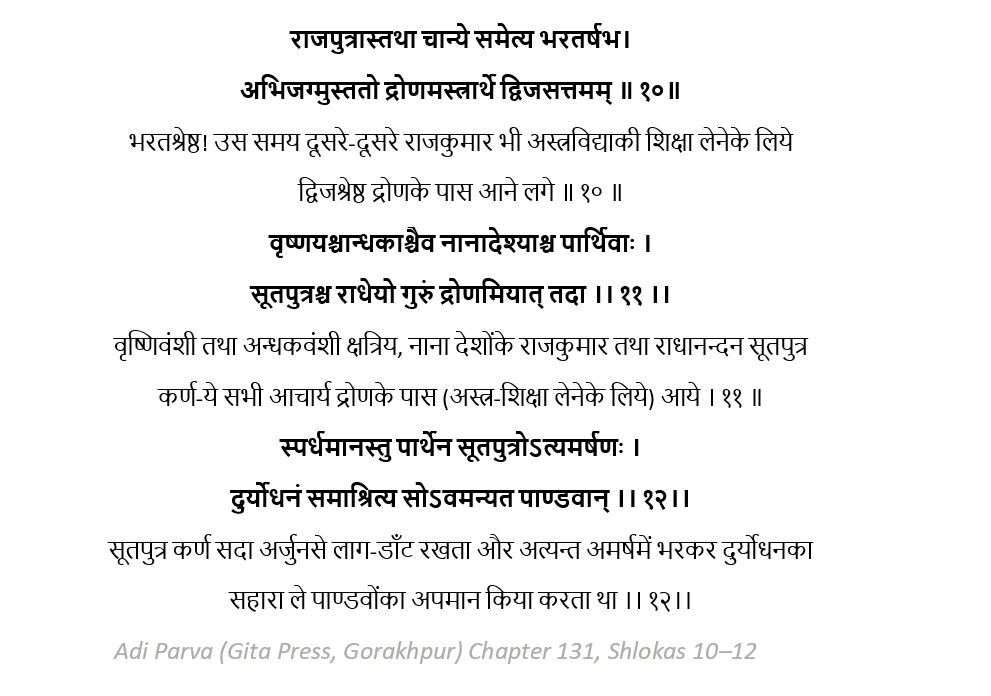
Many popular television adaptations and retellings of the Mahabharata portray that Karna was refused education by Dronacharya because he was believed to be the son of a charioteer. However, the Gita Press, Gorakhpur edition of the Mahabharata presents a different detail.
In Adi Parva (Volume 1), Chapter 131, Shlokas 10–12, it is mentioned that Karna also approached Dronacharya to learn the science of weapons. The passage further describes Karna as a constant rival to Arjun while standing in support of Duryodhan, indicating that he was present among the students connected to Dronacharya’s training.